
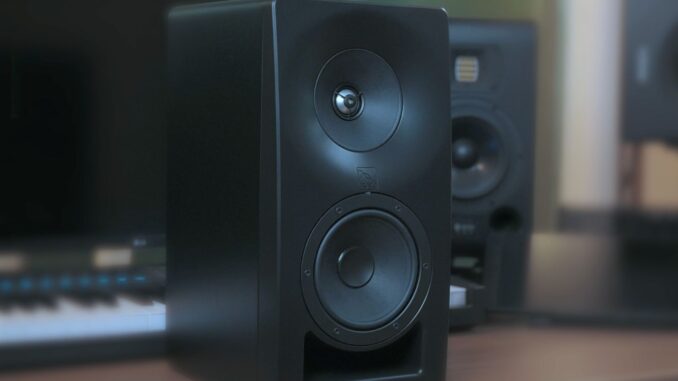
Kali Audio launched the SM series of Studio monitors in 2024. These high-end speakers have gained significant attention in recent times thanks to their competitive price point and ability to compete alongside some of the heavyweights of the industry. Kali Audio, founded in January 2018 in California, is a young company compared to longstanding industry leaders like Genelec and Adam Audio. Despite this, it has quickly established itself as a disruptor within the studio monitors space.
The newly released flagship “Santa Monica” series (SM-5) now represents Kali’s highest-performance monitor, targeting upper-tier users and competing directly with Genelec’s 8000 series and Adam’s S-series. Beating the benchmarks set by their older high-end IN-8 studio monitors, the SM-5 offers almost double the power of the IN-8, additional DSP shaping, and is purpose-built for immersive and critical mixing. The SM-5 is a three-way, active speaker with a 5-inch woofer, 4-inch midrange, and 1-inch coaxial metal dome tweeter, with each driver powered by dedicated sections of a 225W Class D amplifier. As Kali Audio states, the SM series prioritizes best-in-class components and a state-of-the-art DSP, providing the listener with an extremely detailed and immersive listening experience.
The LP series cemented Kali’s reputation among entry-level and semi-pro music communities, but the SM series is built to challenge the industry’s top monitors. Here’s our take on the SM-5. We recently put the Kali Audio SM-5 to test, and here’s what we think about the monitors so far.
Design and Build Quality
The SM-5 features a compact, vertical rectangular cabinet measuring 15.6″ (39.6 cm) in height, 7.9″ (20 cm) in width, and 9.8″ (24.8 cm) in depth. Overall, the speakers felt slim and easily positionable on most studio desks or stands. Design-wise, the SM5 keeps things simple with a matte black finish, accented by a subtle LED logo on the front that doubles as a touch control for power and status.
The SM-5 features four M5 tapped inserts (mounting holes) on both its top and bottom panels for securely attaching the speaker to walls, ceilings, or frames. For immersive studio environments, the speaker’s position can be set at desired angles, and the bracket mounts ensure support for the SM-5’s substantial weight.
Talking about the material used, the Kali Audio SM-5 is constructed from a robust, tree-derived wood composite and finished in matte black paint. Boasting a three-way coaxial design, the drives are built of paper cones for both woofer (5 inch) and midrange (4 inch), along with a 1-inch aluminum dome tweeter.
Kali Audio has paid a lot of attention to detail with the SM series. There’s a USB-A port located on the front for easy uploading of firmware updates via a USB stick, probably one of the most underrated features of the SM-5. There’s also a capacitive touch logo on the front panel that doubles as both a control and a status indicator. The multi-color LED indicator on the front provides status feedback as well. A single tap on the logo shows whether you’re running a user EQ (light blue LED flash) or Kali’s default tuning (solid blue), while a double tap puts the speaker into standby mode (orange). Press and hold wakes it back up. The LED also changes color to communicate key functions—white for level adjustments, green for firmware updates, light blue for EQ updates, and red if there’s a fault.
Talking about the rear panel, the inputs include balanced XLR and TRS analog connectors, AES/EBU digital interfaces via BNC connectors, and an RJ45 Ethernet port for network control and DSP configuration through Kali’s Control Panel software. Physical controls on the rear include a rotary trim knob with precise 0.5 dB steps, adjustable from -12 dB to +6 dB, and a DIP switch block for applying preset adjustments like low-frequency boundary compensation and high-frequency level trims.
The rear also houses the front-firing bass port to maximize placement flexibility without excessive port-induced disturbances like chuffing.

Features and Specifications
The SM-5 is a three-way active monitor featuring:
- 5-inch optimized paper cone woofer for low frequencies,
- 4-inch optimized paper cone midrange driver,
- 1-inch aluminum metal dome tweeter for highs.
Total harmonic distortion (THD) is impressively low: under 0.75% at 90 dB SPL measured at 1 meter, ensuring clear and uncolored sound reproduction. Frequency response is measured at 47 Hz to 21 kHz with a wider range (-10 dB) down to 39 Hz and up to 28 kHz, covering typical studio monitoring needs effectively. Crossover points are at 280 Hz (woofer to midrange) and 2800 Hz (midrange to tweeter).
The SM-5 uses tri-amped Class D amplification with a total power of 225 watts distributed across the woofer, midrange, and tweeter amplifiers. Low system THD and controlled power distribution contribute to high SPL peaks up to 117 dB at 1 meter, which is one of the best among its competitors.
A signature Kali feature in the SM series is the use of physical DIP switches on the rear panel to apply boundary EQ settings. These switches allow quick correction for typical room placement anomalies such as wall, corner, or shelf boundary bass boosts. This hardware-level room tuning is complemented by software DSP for more detailed parametric EQ, delay, and trim control. The extensive DSP functionality is what sets the SM series ahead of its competitors.
The SM-5’s Class-D amp comes loaded with DSP that manages voicing, crossovers, and built-in protection. Quick tweaks like boundary EQ and LF/HF trims are handled with rear DIP switches, while the Kali Control Panel software gives access to deeper room calibration with parametric EQs, delays, and trims—all with zero added latency.
The SM-5 employs a proprietary waveguide with a concentric (coaxial) midrange and tweeter driver, which is a hallmark of Kali’s approach. The stereo imaging is excellent, and the speakers are able to deliver a consistent off-axis frequency response. The dual-coincident drivers on the SM-5 minimize comb filtering and phase issues common in multi-driver systems.
Key technical specs:
| Drivers | Woofer: 5″ optimized paper cone Midrange: 4″ optimized paper cone (coaxial with tweeter) Tweeter: 1″ metal alloy dome |
| Amplification | Class D, tri-amped (separate amps for woofer, midrange, tweeter) Total power: 225 W RMS |
| Frequency Response | ±3 dB: 47 Hz – 21 kHz -10 dB: 39 Hz – 25 kHz |
| Crossover Frequencies | Woofer → Midrange: 280 Hz Midrange → Tweeter: 2800 Hz |
| Performance Metrics | Maximum SPL: 117 dB peak at 1 m THD: <0.75% (100–450 Hz), <0.5% (>450 Hz) at 90 dB SPL |
| DSP Features | 8-band parametric EQ Delay: 10–12 ms per speaker Gain trim: -12 dB to +6 dB DSP latency: <3 ms |
Performance
The SM-5 features a 5″ woofer with a bass extension that reaches down to about 39 Hz (-10 dB), with a well-controlled but not aggressive low end. Rather than a booming sub bass, the SM-5 focuses on the clarity of the bass, delivering a much tighter and cleaner sound without muddiness. For critical listening, the SM-5 pretty much ticked all boxes for us, but unfortunately, it doesn’t work as a subwoofer substitute.
The dedicated 4″ midrange cone is extremely detailed and delivers a natural frequency response with minimum coloration, significantly improving the clarity and presence of the vocals and instruments. Whereas the 1″ aluminium dome tweeter employs special geometry to minimize resonance and harshness. We found the highs quite detailed without being sharp or sibilant. Overall, the model competes well with ADAM Audio’s A7V or the Neumann KH 120 II.
Iconic of Kali Audio, the coaxial waveguide design impresses with its stereo image. The point-source architecture eliminates common issues with off-axis coloration and phase…